Not Every Ledger Belongs on a Tiny Device
There is a recurring mistake in conversations about distributed ledgers for IoT: people start with the ledger and end with the device. The survey A Survey of Distributed Ledger Technology for IoT Verticals quietly inverts that order. It starts from the uncomfortable fact that tiny devices have weak processors, small memories, limited power budgets, and thin wireless links. Once you begin there, the “just use blockchain” reflex becomes much harder to defend.
Read this way, the paper is not mainly a catalog of prior work. It is an argument that DLT for IoT is a matching problem. The right prototype, consensus rule, and architectural trade-off depend on what the devices can actually afford and what the application really needs.
The quiet shift in perspective
The question is not “Can blockchain help IoT?” The better question is “Which ledger assumptions survive contact with low-power devices, narrow bandwidth, and latency-sensitive workloads?”

The survey's most valuable contribution is architectural: it adds hardware and function layers so IoT constraints stay visible all the way up the stack.
Why the hardware layer changes the conversation
The six-layer architecture in the survey is memorable because it refuses to let software abstractions float free of physical limits. Power, computation, storage, wireless bandwidth, and sensing capacity are not implementation details. They are first-order design variables. That single move makes the rest of the survey far more practical.
Once the hardware layer is explicit, you can no longer pretend that every consensus mechanism or ledger structure is equally plausible in every vertical. A smart meter, a logistics tracker, and a connected vehicle may all want distributed trust, but they do not want the same trust machinery.
A ledger is a trade-off, not a checkbox
The survey's other enduring idea is its trade-off framing. DLT systems are often sold as if they can maximize decentralization, strong security, and high performance at the same time. The paper insists that real systems do not get that luxury, especially not on resource-constrained IoT deployments.
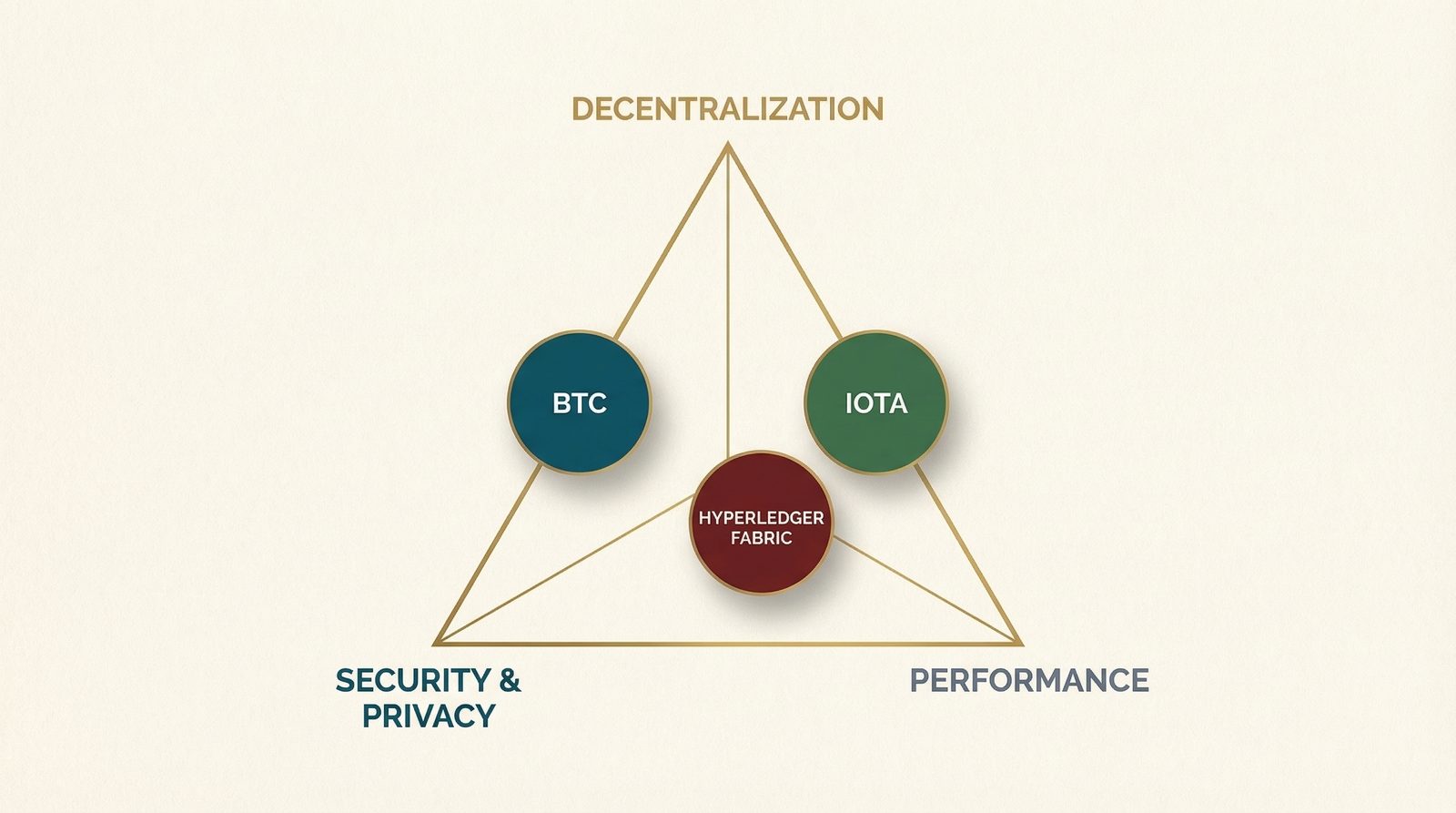
Different ledger prototypes land in different parts of the trade-off triangle. Choosing one is choosing a compromise.
This trade-off framing matters because it turns ledger selection into architecture rather than ideology. If the application needs extreme throughput and low fees, a DAG-like design may be attractive. If it needs stronger conservatism around security and auditability, the compromise shifts. The right answer is conditional, not tribal.
The consensus formulas are simple, but the consequences are not
The survey includes compact expressions for Proof of Work and Proof of Stake. These formulas are not the paper's deepest theoretical contribution, but they are useful anchors because they remind us that consensus rules eventually cash out as resource costs.
Proof of Work
$$H(\mathrm{nonce} + \mathrm{Block}) < \mathrm{Target}.$$
Proof of Stake
$$H(\mathrm{StakeModifier} + \mathrm{Timestamp}) < \mathrm{BaseTarget}\cdot \mathrm{CoinAge}.$$
Why put these formulas in a blog post? Because they make the survey's systems argument tangible. They show that a consensus mechanism is not merely a governance choice. It is a computation pattern with latency, energy, and hardware implications. In IoT, those implications quickly become design constraints.
What the knowledge-graph move actually buys us
The paper also uses an extended knowledge-graph perspective to organize the literature. That may sound like review machinery, but it does something intellectually useful: it stops the survey from being a flat list of papers. Instead it highlights how the field moved from raw blockchain enthusiasm toward more differentiated questions about industry verticals, scalability, DAG variants, and IoT-native designs.
That move matters for readers because it encourages a more mature research habit: do not ask whether a ledger is fashionable. Ask what the field has already learned about fit, mismatch, and missing layers.
Where I think the conversation should keep going
- IoT-native ledgers. Systems should be designed from the constraints upward, not adapted downward from financial blockchains.
- Vertical-by-vertical design. Smart energy, manufacturing, and autonomous mobility do not need the same ledger assumptions.
- Joint design with edge AI. The future is not only DLT over IoT; it is DLT, edge learning, and coordination logic co-designed for one deployment environment.
If there is one sentence I would carry away from this survey, it is this: not every ledger belongs on a tiny device. Some do. Some do not. The whole point of architecture is to know the difference before deployment makes the decision for you.
Primary sources: arXiv, ACM Computing Surveys DOI.